Showing posts with label reviews. Show all posts

Wednesday, December 27, 2017

2017's Christmas Movie: The Christmas That Almost Wasn't (1966)

While my Warhammer 40K blog has seen the occasional post, my general blog has been practically abandoned for the past couple years. Hopefully I can change that with at one or two entries every month or so.

Some traditions, no matter how ill-advised, just won't die. Every December for nearly a decade I've watched at least one Mystery Science Theater 3000 or RiffTrax Christmas movie. Sadly, I neglected to record which movie I watched in 2015, but I'm pretty sure it was either Santa Claus Conquers the Martians (1964) or Santa Claus (1959). In 2016 my Warhammer/X-Wing gaming group watched a collection of Christmas shorts released by RiffTrax as Santa's Village of Madness. Although these weren't quite as excruciating as Santa and the Ice Cream Bunny (1972), they were at least on par with The Magic Christmas Tree (1964).

Only an excess of Christmas spirit could possibly explain why I watched three Christmas-themed movies this year. I started out with Santa and the Ice Cream Bunny, followed it up with The Magic Christmas Tree, and finished it with The Christmas That Almost Wasn't (1966). The latter movie was riffed as part of Season 11 of the revived Mystery Science Theater 3000.

The "Almost" in the title is kind of a spoiler, isn't it?

In the joint American-Italian film, The Christmas That Almost Wasn't, we learn that Santa long ago built his comically small workshop at the North Pole with the Eskimo's permission. Unfortunately, the Eskimo have recently sold the land to a miser named Phineas T. Prune (as expected for this kind of film, the filmmakers either don't know that there is no dry land at the geographic North Pole or have chosen to ignore the fact). Prune isn't nearly as generous as the original landowners and demands rent from the Jolly Fat Man, whose job doesn't exactly pay well. If the rent isn't paid by midnight on Christmas Eve, the workshop and the toys within will be confiscated.

Proud owner of a large slab of sea ice north of the Arctic Circle

With only a couple weeks to go before Christmas Eve, Santa seeks out the help of a kindly lawyer named Sam Whipple, who just happens to live in the same town as Prune. Although Saint Nick is in disguise, Whipple immediately recognizes him and gladly agrees to represent Santa. Sadly, their attempts to reason with Prune go nowhere; the miser admits that he doesn't actually care about the money. The truth is that Prune, who genuinely believes that he was never a child, loathes children and despises Santa's annual tradition of gift-giving.

With no other option but to come up with the money, Whipple suggests that Santa get a job at the local department store. The lawyer sells the store's manager on the idea of letting his bearded friend "pretend" to be Santa, asking children what they want for Christmas and generally attracting customers, thus inventing the idea of the department store Santa. Whipple also gets a side job as the store's janitor, although he spends more time playing with toys and acting as Santa's helper than actually cleaning.

While Santa easily gets the job of playing himself, he's extremely nervous about his first day at work. The reason why is surprisingly clever for a children's Christmas movie from the mid-60s. For centuries Santa has been leaving gifts for children in the middle of the night while they were sleeping; he has never actually spoken with a child and doesn't know how to interact with them. Whipple is put in the unexpected position of coaching Santa Claus himself on how to ask a child what he or she wants for Christmas and how to give a boisterous "ho, ho, ho". Santa, as portrayed in The Christmas That Almost Wasn't is a kindly but quiet man whose personality doesn't match people's expectations.

It's fortunate that Santa's first interaction with children wasn't
with the spoiled hellions that you often find at the mall

Santa quickly adapts to his role once the children start lining up to see him. Despite Prune's and his creepy butler's attempts to sabotage them, Whipple and Santa have earned enough to pay the rent by the close of business on Christmas Eve. (That a couple weeks' worth of a janitor's and a department store Santa's salary could pay the rent is probably the least believable part of the film.) However, before they can pay off Santa's landlord, a concealed Prune and his butler start knocking toys to the floor. As Santa and Whipple puzzle over the inexplicably broken toys, Prune appears and reveals that he bought the department store earlier that afternoon. While he will certainly pay Santa and Whipple what they're owed, he insists that they cover the cost of the items that were damaged on their watch.

Left with nothing, a devastated Santa Claus wanders out into the town square. When a little boy asks him what's wrong, Whipple informs him of the situation. The boy insists on giving him what little money he has, declaring that it's the least he can do for a man who has shown so much generosity. The boy then starts waking all the children in town, telling them that Santa is in trouble. Saint Nick is soon swarmed by children carrying their purses and piggy banks. With literally seconds to spare, Santa pays the irate Prune with an enormous pile of coins.

With the debt paid and the time short, the elves, Santa, Mrs. Claus, and Whipple load the sleigh. Breaking from tradition, Santa decides to take the latter two along so that he can finish his deliveries in time. Just before Santa can fly off, his chief elf, Jonathan, hands him a final package.

After an overlong montage of still photos depicting them distributing gifts, the three discover that the last package of the night is intended for Prune. When Prune awakens to find the three uninvited guests in his home, Santa gives him the gift, which turns out to be a toy sailboat. Along with the sailboat is a letter from Jonathan. Apparently, while looking for any record of a young Phineas T. Prune, Jonathan discovered a long-misplaced postcard from a five-year-old Phineas asking for a sailboat. In the letter, Jonathan apologizes for the error and the resulting delay in delivering the gift.


He has his own sleigh, flying reindeer, and a magic bag
that can hold as many packages as necessary; has Santa
considered a side job as a subcontractor for FedEx?

With the sailboat in hand, Prune begins to remember his youth and how the disappointment of the missing sailboat had soured him on childhood and children. Realizing that he has wasted years of his life wallowing in bitterness, Prune rushes out of his house with his toy sailboat and begins greeting people in the town square and wishing them a Merry Christmas. When he notices one little boy admiring the sailboat, Prune chases him down and practically shoves the boat into his hands, apparently having learned in the space of a few minutes that it is better to give than to receive. The film ends with Prune inviting the town's children to a Christmas party in his spacious (but cobweb-filled) home that certainly lacks any of the essentials for hosting a party.

The Christmas That Almost Wasn't is a surprisingly decent film. Of course there's enough badness to give Jonah and the 'bots plenty to work with. For example, the film has some pretty terrible musical numbers. These scenes seem totally out of place since there aren't enough of them to make the movie a real musical. The elves are more creepy than funny, especially the head elf, Jonathan. And Santa sometimes comes across as a bit too dour. At the same time, like Santa Claus, the movie has some surprisingly effective scenes. As I mentioned before, it was a clever decision to portray a Santa who is initially reluctant to interact with children. But the happiness he shows when he finally gets to meet the children who love him so dearly is genuinely sweet.

Since a movie can be made or broken by its villain, it's fortunate that Phineas T. Prune is effectively played by Rossano Brazzi; an internationally-known actor who had been the male lead in films with actresses such as Katharine Hepburn and Joan Crawford. Brazzi plays a reasonably comical character who avoids being as over-the-top as the villains in movies like Santa Claus Conquers the Martians. While Prune's conversion from Grinch to kindly old man is a bit sudden, it's reasonably well done.

The Christmas That Almost Wasn't is the fourth film I've seen as part of the MST3K revival. When I first heard that Netflix was going to continue the show, I was skeptical that it could match the quality of the original series. However, I was pleasantly surprised to find that the first episode of the new season, Reptilicus (1961), was as well done as some of my favorite classic episodes. Nor have I been disappointed by any of the other episodes I've since watched. Hopefully the new MST3K has found a long term home on Netflix.

Saturday, November 28, 2015

Video Game Review: Star Wars Battlefront

Although my wife and I have owned an XBox, a Wii, and a PS4 over the past decade or so, we're very casual gamers. The bulk of our video games are the Lego games, games that appeal to our specific interests (e.g., Godzilla fighting games, Star Wars games, Disney Infinity), and games that we bought out of nostalgia (e.g., Super Mario Brothers Wii). Despite their general popularity, we've never been fans of shoot-em-up games. In fact, I think I've played the original Halo only once or twice at a friend's home. The only exceptions, however, have been Star Wars: Battlefront (2004) and Star Wars: Battlefront II (2005).

After waiting nearly ten years for a Star Wars: Battlefront III, we were very excited to hear that EA was going to release Star Wars Battlefront in 2015. We were a little worried when we heard that there would be no single player campaign and limited two player options, though. We had really enjoyed the previous games' campaigns and often played against each other in split screen mode. Nevertheless, we pre-ordered Battlefront and eagerly awaited its arrival.


The Good
The Graphics
First and foremost, the graphics are amazing. When you're used to cartoonish games like Lego Batman III or Disney Infinity, you don't realize how incredible the graphics on a PS4 can be. It's hard to imagine the Star Wars universe being better rendered than it is in Battlefront.

Weapons Variety
The first and second Battlefront allowed you to choose a troop type, which dictated your weapon. Now you can choose from a variety of blasters of varying destructive power, range, firing rate, and cooling rate. The wife is fond of the DL-44 (Han Solo's favorite model of heavy blaster pistol with a low rate of fire but a high degree of lethality) while I prefer the RT-97C (a heavy blaster rifle with a very high rate of fire and relatively long range). The secondary weapons, such as ion torpedoes, are pretty decent, too.

Entertaining Single Player/Co-Op Missions
Although there's no single player campaign, there are single player and two player modes. "Training Missions", "Survival Missions", "Battle Missions", and "Hero Battle Missions" (collectively referred to as "Missions") can all be played by one or two players, which is exclusively how my wife and I play. In and of themselves the Missions are reasonably fun and challenging, at least for a couple casual players who haven't played a game like this since the original Battlefront games.


Hero Battle Missions give you a decent array of Heroes to choose from, including Han Solo, Luke Skywalker, Leia Organa, Boba Fett, Darth Vader, and Emperor Palpatine. Heroes in the new Battlefront are a lot more versatile and fun to play than they were in Battlefront II.

The Bad
No Clone Wars?
Both the original Battlefront and Battlefront II allowed you to play during the Clone Wars as well as the Galactic Civil War. If you set your battle during the Clone Wars, you could play as a Clone Trooper or a CIS battledroid. If you were fighting in the Galactic Civil War, you could be a Rebel soldier or an Imperial Stormtrooper. Each army played differently and the setting of the battle determined what vehicles were available for play.

Unfortunately, the new Battlefront is set strictly during the Galactic Civil War, which drastically decreases the historical scope of the game compared to its predecessors.

Limited Map Options
Currently all game modes are restricted to just four planets: Hoth, Endor, Tatooine, and Sullust. For Survival and Battle Missions there appear to be only one or two maps per planet. And then you don't even get to choose which of the two maps you play on; the map you get depends on whether or not you choose the Survival Mission or the Battle Mission. I believe that multiplayer modes have a few more maps, but all are set on the same four planets.


The new game simply doesn't compare to the earlier games when it comes to variety. Veterans of the original Battlefront will remember these maps:
Bespin (Platforms and Cloud City)
Endor
Geonosis
Hoth
Kamino
Kashyyyk (Docks and Islands)
Naboo (Plains and Theed)
Rhen Var (Harbor and Citadel)
Tatooine (Dune Sea and Mos Eisley)
Yavin 4 (Arena and Temple)
Battlefront II had even more maps:
Coruscant
Dagobah
Death Star
Felucia
Kamino (Clone Facility and Tipoca City)
Mustafar
Mygeeto
Naboo
Polis Massa
Tantive IV
Tatooine (Jabba's Palace and Mos Eisley
Utapau
Yavin 4
Geonosis
Hoth
Endor
Limited Features for Missions
One of the appeals of the original Battlefront games was the ability to jump into a vehicle and fly/skim/stomp around the battlefield. If you want to play the new game's Missions instead of multiplayer modes, you won't be doing any of that. Training Missions allow you to zip around in an X-wing or a speeder bike, but nothing else. Neither Survival or Battle Missions allow you to use a vehicle.

What side you play is also limited. Only Battle Missions allow you to choose between the Empire and the Rebellion. If you play a Survival Mission, you're always stuck with the Rebellion.

Finally, while the game allows you to choose your blaster beforehand, you have no choice in what kind of soldier you play. The original games allowed you to play as dedicated snipers, jump troopers (I was very fond of the Darktrooper), demolitions specialists, etc. In the new Battlefront's missions you're always a generic trooper, albeit one with a relatively wide selection of weapons.

The Overemphasis on Multiplayer Modes
I suppose it's unfair to judge Battlefront based solely on the offline content, but that's really the only way my wife and I want to play the game. We have no interest in playing against a bunch of anonymous teenagers or hardcore gamers who will regularly wipe us out with a perfect headshot less than 30 seconds after respawning. Thus, we find it a bit irksome that EA put so much of its focus on the multiplayer portions of the game, with the Missions seeming like an afterthought. According to EA's Chief Operating Officer, Peter Moore, the single-player aspect was downplayed because "very few people actually play the single-player on these kinds of games. That’s what the data points to."

"These kinds of games"? I assume he means first-person shooters rather than Star Wars-themed combat games. Perhaps what he says is true of most first-person shooters, but I can't help but to wonder if EA didn't really consider the property the game is based on or the kinds of people that would be interested in it. EA seems to have assumed that the bulk of Battlefront players will be veterans of games like Call of Duty or Halo. One first-person shooter is the same as another, right?


But this is a Star Wars game. Maybe there are a lot of Call of Duty fans who want to play as an Imperial Stormtrooper for a change, but what about customers who are only interested in a shoot-em-up game because it's set in the Star Wars universe? Those who are only playing the game because they want to kill some Rebel scum or drive an AT-AT aren't going to enjoy themselves if they're getting slaughtered by experienced Halo players.

While it's fun to run around as a Rebel soldier or an Imperial Stormtrooper, focusing almost exclusively on simply shooting other soldiers is contrary to what Star Wars is supposed to be. Traditionally, Star Wars has been about telling a story punctuated by galactic combat. Some of the best Star Wars novels (e.g., the Republic Commando books by Karen Traviss) are about 10% action and 90% character development. Battlefront II had a great single player campaign in which you played a clone in the 501st Legion whose 25-year-long career began with the first Battle of Geonosis and ended sometime after the Battle of Hoth. The storytelling was simple, but it made you care about your unnamed clone avatar. Although entertaining, in its current form the new Battlefront aspires to be little more than a typical first-person shooter with a beautifully rendered Star Wars skin.

Was the Game Released Unfinished?
My wife and I are suspicious of any video game linked to some sort of event. One of the best examples of this is the first Lego Indiana Jones, which was released around the same time as Indiana Jones and the Kingdom of the Crystal Skull (2008). The development of Lego Indiana Jones was clearly rushed so it could benefit from the movie's advertising campaign, resulting in one of the buggiest video games in a long line of often buggy (but otherwise entertaining) Lego games.

Because of previous experience, I was concerned that the release date of Star Wars Battlefront was timed to precede Star Wars: The Force Awakens by a month. Although the game doesn't seem to be as buggy as I feared it would be, I suspect that the developers deliberately minimized the amount of content so they could put their efforts into a game that looked good and functioned as expected.

One of the most common complaints I've read about Battlefront (and one I've mentioned above) is that the content of the game as released is rather thin. I think EA knew this was going to be the case, hence the early promises of future DLCs. Well before the game's release, EA announced that its first DLC would be the Battle of Jakku (Jakku is a desert planet that will appear in The Force Awakens). This download, which will contain two new maps as well as a whole new multiplayer mode called Turning Point, will be available for free. (It's still not entirely clear if the maps will be available for Missions.) [Update 12/5/2015: sadly, the Jakku maps are only available for multiplayer mode.]

If the Battle of Jakku is free, why didn't EA include the maps and Turning Point in the original game? Similarly, a week after the Battlefront's release, EA's Executive Vice President, Patrick Söderlund, promised "to support Star Wars Battlefront with new content well into the future" and said that EA would add "more of what you love about the game, like new maps and Star Cards, for free in the coming months, in addition to all of the content we have coming with Season Pass." The fact that they're producing free DLCs suggests that they knew they were going to release a $60 game with too little content and intended to fix it later.

I only hope that they throw some of us old-timers a bone and enhance the single player/split screen aspects of the game.

The Summary
All my ranting to the contrary, I actually enjoy Star Wars Battlefront quite a bit. I'm particularly happy with the graphics and weaponry, which go a long way toward making you feel like you're taking part in the Star Wars universe. I would have preferred a bit more content in the initial release, though. And the threadbare single player/two player material leaves a lot of us casual players who are fans of Star Wars more than fans of first-person shooters out in the cold. EA's stated intention of enhancing the game in the future gives me some hope that they might beef up the Missions or even include a single player campaign.
B-

Sunday, September 27, 2015

Book Review: Zombie War: An Account of the Zombie Acopalypse that Swept across America

Sometime in the near future, a virus engineered by the former Soviet Union ends up in Iranian hands. The virus, designated F1-st, is deadly within minutes, but causes its victim to reanimate into a snarling, vicious terror only a short while later. When a handful of zealots sneak into Miami and deliberately inject themselves with the virus during a football game, the resulting epidemic entirely envelops Florida and quickly spreads to adjacent states.

Thus begins Zombie War by Nicholas Ryan, an Amazon bestselling horror writer who has found a niche in the popular field of zombie literature. While the prologue is written as a third person narrative, the remainder of the book is told in the first person by journalist John Culver. Culver spends the bulk of the novel visiting dozens of individuals and places to chronicle the 13 month long Zombie War that saw Florida, Mississippi, Alabama, Georgia, and South Carolina overrun by the undead.

Zombie War vs. World War Z
The plot of Zombie War will inevitably remind many readers of World War Z. In fact, the author invites the comparison by pasting a reviewer's claim that the book is "As good as World War Z" directly on the cover. (It was through my review of Brook's novel that Ryan found this blog and asked if I would like to review Zombie War.)

While the format of the story may be similar to Max Brook's novel, Ryan's zombie apocalypse is different in several ways.

The Zombies
As I mention in my review of World War Z, much of the plot is driven by the characteristics of the classic Romero zombie; a shambling, mindless creature compelled to eat human flesh. While Romero's films aren't too particular on the nature of zombification, Brooks invents the solanum virus to explain his lurching horrors.

Like Brooks' ghouls, Ryan's zombies are reanimated by a virus. However, F1-st's victims are howling, aggressive, and fast; i.e., post-28 Days Later (2002) zombies. In World War Z, Brooks emphasizes the futility of using modern weapons, which are often designed to kill with blast overpressure, on a creature that is no longer dependent on internal organs or even a fully intact brain. In Ryan's book, the fact that the zombies come running at the first sound or sign of movement means that the US military is often as concerned with crippling or slowing the monsters as it is with killing them.

The Crisis
The nature of Zombie War's crisis leads to a very different war from that in World War Z. The pandemic that becomes World War Z originates in China and spreads through refugees. Solanum's victims often live long enough to travel long distances via truck or airplane, ensuring that the virus spreads far and wide (in at least one case, the virus makes it to Brazil through an infected organ from a Chinese "donor"). The widely spaced epidemics that result grow together into an undead pandemic. Although the undead are slow, the diffuse nature of the pandemic makes it difficult to counteract. The reaction time of the world's governments is further slowed by Chinese secrecy and a misunderstanding of the virus' effect on its victims.

By contrast, Zombie War's F1-st epidemic starts in one location, Miami's Sun Life Stadium, through a single act of terrorism. The F1-st virus kills and reanimates a victim in minutes, thus creating a full-blown zombie horde in record time, but one that is geographically limited and moves only at footspeed. The threat that the rapidly growing mob of flesh-eaters poses is obvious, meaning that America knows what it's dealing with pretty quickly.

The Living Fight Back
In World War Z, most of the world's governments find themselves gathering as many of their citizens as they can into isolated and defensible locations (e.g., parts of the Rocky Mountains). The collapse of civilization means that fuel, vehicles, and armaments are scarce. On top of that, the living are forced to devise innovative ways to fight an enemy that's already dead. Brooks' post-apocalyptic army has no use for tanks or artillery, having found them to be ineffective during the infamous Battle of Yonkers in the early days of the war. Instead, the US military dresses its soldiers in bite-proof fatigues, arms them with bolt-action rifles, and lures the zombies to well-stocked garrisons where Civil War-era formation firing is employed to whittle down their numbers.

Although a substantial portion of the South has to be conceded to the horde, Zombie War's US military is able to construct the Danvers Defense Line (a network of trenches, razor wire, and fences built along major highways) to stop the spread of the zombies. The line forms the centerpiece of the appropriately named "Operation Containment" (code names don't need to be secret when your enemy has no intelligence to speak of).

Ryan's zombies are fast, which neutralizes tactics like formation firing. Additionally, the military in Zombie War is left mostly intact. Fuel and equipment aren't an issue, so massed tank formations can be mustered. After the advance of the zombies is stopped at the Danvers Defence Line, tanks, infantry carriers, and self-propelled artillery are used to push the creatures towards Florida as part of "Operation Conquest". In the final phase of the Zombie War, "Operation Compression", the zombies are pushed into the Florida peninsula and contained behind a second defense line. (Ryan's zombies may be fast, but apparently they can be contained by water. World War Z's zombies often wandered into the ocean and could pop up weeks to months later on a distant beach.)

My Impressions
There are a lot of good ideas in Zombie War. One of the best of these is the use of waves of artillery fire to slow down and immobilize the zombie hordes. Yes, artillery may simply immobilize a zombie rather than kill it, and yes, an immobilized zombie is still dangerous, but at least it allows troops to deal with them on their own terms. Given that World War Z's military completely abandons artillery as useless, I have to wonder if Ryan's story is intended to be a direct rebuttal to Brooks' novel.

The tactics employed during Operation Conquest are interesting and would look very impressive on film. Imagine dozens of Abrams battle tanks driving side-by-side, mowing down zombies with machine gun fire and running over the rest. Two miles behind the Abrams are armored personnel carriers filled with soldiers to clean up what the tanks leave behind.

While I like a lot of the novel's ideas, there are a couple aspects of Zombie War that fell flat with me. For starters, I just don't find John Culver to be that interesting. He's supposed to be a journalist and the bulk of Zombie War is supposed to be an account of America's response to the zombie virus, but much of the story consists of Culver describing his impressions, feelings, or responses to the interviewees. I don't care for real journalists who think we need to know how they feel about the story they're covering; I feel the same way about fictional journalists, too.

Second, the interviews with multiple high ranking military personnel are very repetitive. With few exceptions, they follow a single pattern: Culver arrives at an interview that has been arranged ahead of time; despite the fact that the interview was prearranged, the officer is gruff and abrupt; Culver asks some softball questions and the officer responds with impatience or even outright hostility; eventually, after recounting the horrors of the Zombie War, the officer lets his guard down and shows that the hardened exterior hides a weary and exhausted man. One or two episodes like this wouldn't stick out, but it seems like the majority of the interviews turns out this way.

I should point out that the author never seems to be denigrating or disrespecting the US military. In fact, the book comes across as unashamedly patriotic (which is odd considering that the author is Australian). Instead, I get the impression that Ryan is trying to portray the kind of no-nonsense and notoriously prickly military officials that were so famous during the '40s, '50s, and '60s; e.g., General Patton, General MacArthur, or Admiral Rickover. But in the face of a much more hostile and ubiquitous media, and without the urgency of a conflict on the scale of World War II or the Cold War encouraging politicians and other senior military officials to overlook difficult personalities, modern high-profile military personnel can't afford to be anything but diplomatic.

By contrast, the interviews with sergeants and various grunts are a lot better: some are good humored, some are gruff, some are matter-of-fact, and some are shell shocked. It would have been nice if their superiors had been handled with the same degree of subtlety.
B-

(Full disclosure: I was provided with a digital copy of this novel in order to review it.)

Tuesday, July 7, 2015

Movie Pseudo-Review: Jurassic World (2015)

I was 14 when I saw Jurassic Park (1993) in the theater. I loved it, of course, and couldn't wait for the inevitable sequels. When The Lost World: Jurassic Park came out in 1997, I saw it with a girl I liked (and married four years later). Although I generally enjoyed the film, it didn't have nearly the impact as the original, and I felt that the San Diego sequence significantly detracted from it.

I'm not entirely sure that I even saw Jurassic Park III in the theater in 2001 or if I first saw it on DVD. By that point, my expectations weren't particularly high. It was entertaining enough, and didn't have anything as stupid as its predecessor's San Diego scenes, but it was disappointing compared to the first film.

Thus, I was somewhat wary when I finally saw the Jurassic World teaser trailer. Sure, it looked pretty cool, but what were the odds that the fourth film in a franchise that had a sharp dip in quality with the first sequel would be any good?

Actually, the odds turned out to be pretty good.

Fortunately, Jurassic World turned out to much better than Lost World or Jurassic Park III. Surprisingly, I even enjoyed it more than Avengers: Age of Ultron. Sure, it's not quite as good as the original Jurassic Park, but how many films could claim that?

Rather than do one of my usual reviews, I think I'll list a few things that really stood out to me. Expect some spoilers ahead:

The Setting
Jurassic Park is set on Isla Nublar while The Lost World and Jurassic Park III are set on Isla Sorna (aka, "Site B"). The first island was meant to be the "showroom" while Site B was where the significant research was done. Although the first movie's pristine, soon-to-be-open park is a lot cleaner than the abandoned and decaying facilities seen in the second and third movies, all three movies have essentially the same setting; an isolated location where a small group of people find themselves at the mercy of uncontrolled dinosaurs. This worked well once, but it was feeling pretty stale by the third movie.

Jurassic World took a different approach. InGen, the company founded by John Hammond sometime before the first film, faced financial ruin and was eventually bought out by Simon Masrani. In fulfillment of Hammond's dying wish, Masrani established Jurassic World on Isla Nublar. The public portions of the amusement park take up the southern half of the island while the northern part contains research facilities. The abandoned Jurassic Park site, which remained effectively untouched since the 1993 incident, also happens to be located in the northern half of the island. By the time of the movie, the park has successfully operated for ten years.

It's refreshing to see the franchise change its setting from an untested and empty park with barely contained animals, or an abandoned facility where the dinosaurs are entirely free to roam, to a well-established and heavily populated park (one where the presence of children isn't an anomaly). It's also apparent that the new owners have learned from their predecessor's mistakes. Instead of electrified fences, animal paddocks use solid concrete walls. On top of that, the facility is proactive in managing risks, including running drills and maintaining a special team for containing escaped animals.

Although we know that there will be dinosaur-related mayhem, part of the fun is watching the well-oiled machine of Jurassic World break down through mistakes, misjudgments, and years of complacency.

Simon Masrani
A movie billionaire CEO that
doesn't deserve to be eaten.
Masrani (Irrfan Khan) easily could have been cast as a villain, or at least as a cynical money-grubbing CEO like Hammond's nephew, Peter Ludlow in The Lost World. Instead, he's a very likeable character who explicitly wants both his park's visitors and the animals to be happy. Although he makes some misjudgments, he's generally cautious; an oddity in disaster films like this one. This is most apparent when he first sees the park's future attraction, the Indominus Rex (a hybrid of multiple dinosaur species and several modern animals).

Instead of gleefully rubbing his hands together and monologuing about how much money the new attraction will bring into the park, he immediately becomes concerned about the animal's apparent aggressiveness. He asks his operations manager, Claire Dearing (Bryce Dallas Howard) to bring in Jurassic World's behavioral researcher, Owen Grady (Chris Pratt), to evaluate the animal and the security of its pen.

When the Indominus inevitably escapes and starts eating park personnel, Masrani personally flies a helicopter loaded with an armed team to kill the animal. Sadly, pursuit of the Indominus leads to the escape of dozens of pterosaurs, which attack the helicopter and destroy it. Masrani's popularity with his employees becomes obvious when we see that several control center employees are left stunned or in tears when video feeds show their boss go down.

InGen's Dinosaurs versus Current Paleontology
At the time of Jurassic Park's release, the depiction of the dinosaurs was considered to be reasonably accurate (with notable exceptions such as the size of the velociraptors). By the release of Jurassic Park III, it was widely accepted that dinosaurs such as velociraptor would have been covered in feathers. The 2007 discovery of quill knobs on well-preserved velociraptor forearm bones is considered to be definitive proof of this.

It's possible that the 2001 film was attempting to explain away the growing discrepancy between everyone's favorite kitchen-stalking terrors and current paleontological reconstructions with a brief line from Dr. Alan Grant (Sam Neill). When asked why he was still digging up dinosaur bones when there were living examples on Isla Sorna, Dr. Grant responded that "What John Hammond and InGen did at Jurassic Park is create genetically engineered theme park monsters. Nothing more and nothing less."

Genetically engineered theme park monsters
(also one of the greatest scenes of 20th century cinema)

More accurate, but not what gave an entire generation kitchen-based nightmares

When Jurassic World's trailer came out, the franchise was attacked by paleontologists for continuing to portray the dinosaurs inaccurately. Rather than introduce a huge inconsistency into the film series by updating the dinosaurs, the writers of the new film took advantage of statements made in Jurassic Park that the DNA of the resurrected animals wasn't entirely ancient. When Masrani confronts InGen's chief geneticist, Dr. Henry Wu, and accuses him of creating a monster in the Indominus Rex, Wu retorts:
You are acting like we are engaged in some kind of mad science but we are doing what we have done from the beginning. Nothing in Jurassic World is natural! We have always filled gaps in the genomes with the DNA of other animals. And if their genetic code was pure many of them would look quite different. But you didn't ask for reality, you asked for more teeth [my emphasis].
With that single line, Jurassic World explains why the films' animals haven't kept up with modern paleontology; at the genetic level they're Frankensteinian creations rather than true dinosaurs. In addition to a hodgepodge of dinosaur genetic material, Dr. Wu admits that the Indominus Rex's genome includes cuttlefish DNA to accelerate its growth rate and tree frog DNA to allow it to adapt to a tropical climate.

Owen Grady
Jurassic Park, The Lost World: Jurassic Park, and Jurassic Park III have two types of people: victims and survivors. The victims are generally random people or those who think they have everything under control. The survivors typically include at least one expert (e.g., Alan Grant or Ian Malcolm) whose skill or experience allow himself and a chosen few to avoid getting eaten.

Jurassic World's Owen Grady (Chris Pratt) introduces one more type into the franchise: the action hero. Grady is a Navy veteran and an expert on deadly animals, has earned the respect of a velociraptor pack (although they're far from tame), and is perpetually cool under pressure. The character is a cliche, but one that the Jurassic Park franchise could really use. Heck, Claire Dearing's nephew simply comes out and says what we're all thinking when Owen Grady is leading the raptor pack from his motorcycle: "Your boyfriend's a bad@$$."

I loved Dr. Alan Grant's character in the first and third Jurassic Park movies, but he definitely couldn't call himself a raptor pack's alpha.

Bad@$$, indeed

I'm looking forward to Jurassic World II.
A-

Friday, December 26, 2014

2014's Christmas Movie: The Magic Christmas Tree (1964)

The Christmas movie tradition continues. Like last year, I started the month by inflicting a Christmas-themed movie on the Warhammer 40,000 gang. Despite repeated warnings beforehand, Santa and the Ice Cream Bunny (1972) earned a lot of groaning and cries of despair. For the evening of Christmas itself, my mother and I watched the RiffTrax take on The Magic Christmas Tree (1964).

The movie is awful, of course. Not Santa and the Ice Cream Bunny awful, though, which is the cinematic equivalent to the time I had an ingrown toenail treated in Mexico and the doctor didn't think local anesthetic was necessary. No, The Magic Christmas Tree is more like the esophageal motility and pH study I had a couple years ago. The one where they put a probe up my nose and down my throat.

Good times...

Again, Mike Nelson, Kevin Murphy, and Bill Corbett of MST3K fame try their best to get us through this movie. Before the feature presentation, though, they treat us to some vintage toy ads, at least one of which my mother remembered. They follow this up with a hilarious cartoon from 1933 called The Shanty Where Santy Claus Lives. I suppose I should rephrase that; the cartoon itself isn't funny in the least. It's one more example of the "wacky animated characters sing and perform slapstick comedy to a jaunty tune" genre of shorts that were so common in the early '30s. It's the riffers' jokes that make the film worth watching.

The film proper starts during Halloween when a husky kid named Mark convinces his two friends to check out the rundown house on the hill. (Once Mark is referred to as "husky", Nelson, Corbett, and Murphy can't help but to constantly refer to that particular character trait.) The home is owned by an older woman who the kids believe to be a witch.

At the same time that the friends are approaching the home, the woman is trying to get her cat, Lucifer(!), out of the tree. The friends eventually chicken out, but Mark eventually comes face to face with the woman. She convinces/frightens/bribes him to get the cat down. I honestly don't remember why he ends up doing it since the film has more padding than almost any movie I've ever seen and my attention started to wander.

Mark succeeds in getting Lucifer down, but he loses his grip and falls. When he wakes up, the world has transformed from black and white to color a la Wizard of Oz, while the old woman is now wearing a literal witch's hat. (Note: do not attempt to emulate a classic movie in your zero-budget film, as it only reminds people of how much they would prefer to be watching that movie than this one.)

Despite her literal witch costume, the old woman says that she's a good witch and wants to reward Mark for getting her cat out of the tree. She gives the boy a box containing a magic ring. Also inside the box is a seed that will grow into a magic Christmas tree when it's buried with the wishbone of the Thanksgiving turkey, the ring is spun around the wearer's finger nine times, and three magic words are spoken. Or something. The whole thing is ridiculously convoluted and is the butt of several of the riffers' jokes. I was surprised that none of them suggested that the three magic words would be "klaatu, barada, nikto".

Well, it's more of a "color" film than it was before 

A cheap calendar effect shows us that most of November has passed and the next thing we know, Mark is planting the magic seed. Well, "next thing we know" is a bit too generous to the film's editor. Marvel as Mark pulls the seed out of his drawer! Thrill as the husky boy explains to his pet turtle what he's about to do! Sweat with anticipation as Mark puts on his slippers, crawls out his bedroom window, eventually finds a place to plant the seed, slowly digs a hole, plants the seed, spins the ring, and says the magic words! All in real time! Seriously, the time it takes for Mark to actually plant the seed is given more screen time than major plot points later in the film.

By the next day, the tree is fully grown. The movie then "delights us" with the endless sequence in which Mark's dumb-as-dirt father struggles to get his lawnmower started, haphazardly trims the grass while "humorous" sound effects (mostly circus horns) fill the soundtrack, and then destroys the machine by running it into the 7 foot tall tree that sprung up on his property overnight. Unable to cut down the tree with a saw or an ax, dad decides the tree is there to stay.

Fast forward to the night of Christmas Eve. Mark's parents and sister (I guess, I don't think the character is ever introduced) find themselves entirely unprepared for Christmas. They don't even have a tree. The family goes out to find one while Mark stays home under the pretense that he has gifts to wrap. Once they're gone, the boy tries to figure out how to use the tree, which the old woman claimed will grant three wishes. The tree begins talking to Mark, its tone and unintentional innuendo providing the riffers with a wealth of material to work with.

Mark's first wish is to have "just an hour" of the kind of power that the tree has. No, the tree doesn't impose any time limits on his wishes, nor does it immediately act on his statement, preventing him from asking for more than an hour. The boy is apparently too stupid to realize that he could just as easily ask for a day, or a week, or a lifetime of near omnipotence.

Once given phenomenal cosmic power, Mark turns night to day (nobody seems to notice) and proceeds to play silly pranks on people. In fact, other than making a woman throw a pie into a baker's face, all he really does is make people's vehicles drive away from them, forcing them to "comically" run after them. A deliveryman, a cop, and several firemen all find themselves chasing after their cars or trucks in another excruciatingly drawn out scene.

"I wish I had never agreed to star in this movie" 

Mark, having utterly wasted his first wish on a single "hour of power" that he used to commit budget-friendly tricks, has to think hard for his second wish. When the tree says that it doesn't have all night since Santa Claus will soon be there, Mark decides that his second wish will be to have Santa Claus all to himself for a day. Not only does this selfish act conjure up Kris Kringle in the boy's living room, but it confines him to a chair located next to the magic tree. Mark declares that Santa will spend the day giving him whatever he wants, which leads to... nothing really. I'm certain I was fully conscious during this scene, but I have no idea what happened. I know Mark told the jolly fat man that he was there to give the little brat whatever he asked for, but in the very next scene the kid is nowhere to be found, leaving Santa to talk to an obnoxious magic tree.

Everything that follows this is tremendously confusing and makes the amount of time spent establishing the planting of the tree and the dad's first encounter with it even more absurd. Sure, when a couple minutes of footage and a line or two of dialog could have established that the seed had been planted, had fully grown in a day, and was indestructible, the filmmakers instead give us endless footage that suggests the editor was out for a coffee break. But when events that are essential to understanding the plot are involved, the movie skimps on the exposition. I suppose it could have been worse; Santa and the Ice Cream Bunny revels in overabundant explanatory dialog, all delivered in the most stilted manner possible.

Anyway, the tree sadly informs Santa that he can't be freed until Mark comes back. Mark is next seen in broad daylight in the woods with what appears to be a pellet gun. Presumably it's Christmas day, Santa missed his annual trip, and the extent of Mark's demands from Santa has been... a pellet gun? So, not only is this kid a selfish brat, but he's immensely stupid to boot, squandering effectively limitless power on stupid tricks and a single toy he could have gotten for any given Christmas.

While wandering around the woods, Mark runs into a giant who declares him to be his slave because the boy is so selfish. Huh?

Up to this point, we had indeed seen a witch, pointy hat and all, a magic, wish-granting tree, and Santa Claus himself. But with those few exceptions, nothing else about the world of The Magic Christmas Tree has led us to believe that child enslaving giants roam the woods. Thus threatened, Mark reneges on his behavior, wishes that it were the day before (this line is the only real indication that this part of the movie takes place on Christmas day), and that his previous wishes had been undone. The disappointed giant declares that he'll have to wait for another selfish little boy.

Having thus learned his lesson (i.e., that selfishness leads to enslavement by giants), Mark wakes up in black and white land to find the old woman looking over him. As we all suspected, he had been knocked unconscious by the fall from the tree and all the color sequences were a dream. Nevertheless, his actions had gotten Lucifer out of the tree and the woman wants to reward him for it. The boy balks initially, afraid that he'll start the whole cycle over again, but instead of a magic ring the woman offers him milk and cookies.

On a side note, while the cheap Christmas novelty that passes as the magic ring gets a lot of attention, it has little to do with the magic tree itself. All Mark does is spin it several times before saying the magic words, which just seems overcomplicated.

This movie further confirms what I suspected with Santa and the Ice Cream Bunny; MST3K did the best of the bad Christmas movies with Santa Claus Conquers the Martians (1964) and the Mexican-produced Santa Claus (1959), leaving the worst films in the public-domain for RiffTrax to mock. I assume that Mike Nelson and the gang prepare for each RiffTrax episode the same way they they prepared for MST3K; by watching each movie multiple times and writing down the jokes as they came to them. I can't imagine those guys make enough money off RiffTrax to justify doing that to themselves.

F (the movie is an atrocity, but the riffing is top notch)

Sunday, October 26, 2014

Music Review: Wonders (The Piano Guys)

Five months is definitely the longest I've ever neglected this blog. Unfortunately, I've not had a whole lot to say on any non-40K subject. However, the Piano Guys have given me something to write about with their new album Wonders.

I first heard about the Piano Guys when somebody linked to their video for "Cello Wars"; an entertaining take on John Williams' most famous Star Wars themes: "The Imperial March", the Force theme, and "Duel of the Fates". It wasn't until much later that I found out that the well-known pianist (at least in Utah) John Schmidt, who I had seen perform at BYU, was the group's piano player.

After seeing the videos for "Titanium/Pavane", "The Cello Song", and others, I was eager to buy their first album, The Piano Guys. They followed this up with another series of videos, including the fantastic "Rockelbel's Canon" (still one of my favorite videos), which ended up in their second album, The Piano Guys 2.

The Piano Guys are still going strong with their latest album The Piano Guys 3 Wonders, which was released earlier this month. The album includes:

"Story of My Life": The Piano Guys are apparently fans of One Direction, having done at least two versions of their songs (the other I'm aware of is "What Makes You Beautiful"). Most of the reason why I like this track is because, like so many of their other works, I can't help but to mentally associate it with their video, which was designed to be a tearjerker.

"Let It Go": Of course they did a cover of "Let It Go"; who didn't? What makes their version unique is how they've mixed it with a classical piece, specifically Vivaldi's "The Four Seasons: Winter".

"Ants Marching/Ode to Joy": I have to admit that I was completely unfamiliar with the Dave Matthew's Band's "Ants Marching" before hearing the Piano Guys' version. If it weren't for the Piano Guys or Weird Al, I would know practically nothing about popular songs or bands. Once again they've mixed it with a classical piece, "Ode to Joy" from Beethoven's "9th Symphony".

"Father's Eyes": A rare song from the Piano Guys; the vast majority of their work is instrumental with occasional non-lyrical vocals in background. Although I like the track, the singer's voice is a bit too high for my tastes.

"Kung Fu Piano: Cello Ascends": This is another cover of a modern work that incorporates a  classical piece. In this case it's an arrangement of "Oogway Ascends" from Hans Zimmer's score for "Kung Fu Panda" (hey, something I recognize!), mixed with Chopin's Prelude No. 20, Op. 28. The video for this was actually filmed on the Great Wall of China.

"Summer Jam": I believe this may be one of the album's original pieces. It's upbeat and kind of fun, but rather forgettable.

"Batman Evolution": Definitely one of the highlights of the album. After opening with Danny Elfman's theme from Batman (1989), the Piano Guys sample music from the campy '60s Batman TV show, followed by another bit of Elfman's score, and then Hans Zimmer's and James Newton Howard's Batman theme from Batman Begins (2005)/The Dark Knight (2008). They finish off the track with a brilliant mix of Elfman's and Zimmer's/Howard's themes. The '60s theme is noticeably absent here, but it would almost certainly feel out of place if it had been included.

"Don't You Worry Child": Another actual song; this time it's a cover of one by Swedish House Mafia (no, I'd never heard of them). Interestingly, the Piano Guys have given the song an Indian-feel and have replaced the song's original words with Hindi lyrics. This may be one of my favorite pieces from the Piano Guys, probably because the singer, Shweta Subram, has a beautiful voice and because I'm a sucker for songs with foreign lyrics (most of my favorite Josh Groban songs are in Italian or Spanish).

"Home": This is a cover of Philip Philip's song (I haven't heard of this guy either, am I that out of touch with modern pop culture?). For people like myself, they've thrown in a bit of Antonín Dvořák's Symphony No. 9 in E Minor ("New World Symphony"). This piece starts out a little slow after the energetic "Don't You Worry Child", but it picks up near the end. And anything with Dvořák has to be good.

"The Mission/How Great Thou Art": This is a mix of a theme from the film The Mission (1986) and the well-known hymn "How Great Thou Art". The music is beautiful, of course, but it's best heard while watching the video, which was filmed at Iguazu Falls and at the foot of the famous Cristo Redentor statue in Brazil.

"Because of You": After some Sunday afternoon music, the Piano Guys give us something more upbeat. I don't know if this is a cover of something or one of their original works.

"Pictures at an Exhibition": This is the Piano Guys' rendition of the "Promenade" melody, variations of which are repeated throughout Modest Mussorgsky's "Pictures at an Exhibition". It also happens to be one of my favorite classical works. While staying faithful to Mussorgky's original, it gives it a much more modern sound.

Although a fan of their previous two albums, I thought that Wonders was stronger than Piano Guys 2. It has more memorable tracks, a lot of variety, and some of their best songs.
A-

By the way, it's always a good idea to watch the Piano Guys' videos. For several of their arrangements, the visuals are a lot of the fun (most particularly for "Rockelbel's Canon").

Sunday, May 25, 2014

Movie Review: Godzilla (2014)

I rarely see movies in the theaters anymore. I don't like crowds, I don't like having to follow someone else's schedule, and I don't like the prices. In the rare cases when I do go to the theater, it's usually weeks after a film's release when there are less people.

However, I've been a Godzilla fan for about 25 years. And I've been waiting to see this movie since it was officially announced in 2010. When I realized that Godzilla (2014) was going to be released a) on my Friday off and b) when most people are in school or at work, I decided to see a movie on its opening day for the first time in years.

The opening credits consists of footage taken of a highly classified event from 1954. For years the world was convinced that the US Government's activities in the Pacific during that time consisted of extensive nuclear testing intended to prove new bomb designs and to intimidate the Soviet Union. However, brief images of an enormous aquatic creature and an atomic bomb with a hastily painted crossed-out monster on the casing show that a lot more was going on than nuclear brinksmanship.

Fast forward to 1999 where Dr. Ichiro Serizawa (Ken Watanabe) of Project Monarch, the secretive organization that was involved in the 1954 event, is taken deep into a collapsed mine in the Philippines. The elevated radiation levels are suspicious enough, but the enormous fossilized bones and the two cocoons confirm his fears. Although one cocoon is intact and appears to be entirely dormant, the second was obviously breached shortly before its discovery. The freshly dug tunnel leading away from the cocoon puts Project Monarch on high alert.

Whatever was in the cocoon makes a beeline for Janjira, Japan, producing seismic waves that has chief engineer Joe Brody (Bryan Cranston) worried about the safety of the nuclear plant where he and his wife (Juliette Binoche) are employed. Soon the reactor has been breached and the plant goes into lockdown, trapping Brody's wife behind a shielded door in a lethally radioactive hallway. As Brody mourns, the ground begins to shake even more violently and the plant collapses into a crater with a roaring sound that's unlike any caused by an earthquake or structural failure. The Brodys' son, Ford (played as an adult by Aaron Taylor-Johnson), has the misfortune of seeing the collapse from his schoolroom. Janjira is immediately evacuated and is permanently abandoned.

Fifteen years later, Ford is a US Navy ordnance disposal technician living in San Francisco with his wife and child. Not long after coming off active duty, the US consulate in Japan informs him that his estranged father has been arrested trying to enter the quarantine zone around Janjira. After retrieving his father and returning him to his apartment near the abandoned city, Ford finds articles on the disaster posted all over the walls, as well as an eclectic collection of books; the oddest being a text on the use of echo-location in animals.

The very next day, Ford finds himself entering the quarantine zone with his father under protest. Although the area is supposed to be extremely radioactive, Joe's Geiger counter finds no trace of radiation. The two return to their former home and find Joe's computer disks on which he has recordings of the seismic wave that was detected prior to the disaster. Joe and Ford are captured almost immediately thereafter, but instead of being outright arrested, they're taken to the former site of the nuclear plant where a enormous project is underway. As Joe is being questioned, Dr. Serizawa realizes that they've found one of the only survivors of the Janjira disaster who knows anything about the events that led up to the collapse of the plant. 

Unfortunately for Joe, Ford, and the Monarch team, activity within the huge cocoon growing in the location of the plant's destroyed reactor is reaching its apex. The radiation emitted by the ruined reactor has been completely absorbed by the creature inside, which has been feeding on it for the past 15 years. When it emerges, the insect-like, electromagnetic pulse-emitting Massive Unidentified Terrestrial Organism (MUTO) immediately destroys the surrounding research facility, unfurls a set of wings, and flies off in search of the MUTO that had been hibernating inside the intact cocoon found in 1999.

With the cat out of the bag, Dr. Serizawa reveals the truth; the newly hatched MUTO is but one example of an ancient creature that lived long before humanity. These creatures fed off of radiation, which was more plentiful on ancient Earth, and became dormant when the background radiation levels dropped off. With the advent of the atomic age, some of these creatures were awakened, one of the first being an enormous reptilian "alpha predator" that Serizawa calls Gojira. Although believed to be destroyed in 1954, Serizawa suspects that it may only be hidden deep in the ocean and that it may be humanity's only hope for eliminating the MUTOs.

Godzilla (which is how everyone but Serizawa pronounces the word) may have been inactive for 60 years, but it doesn't take him long to detect the presence of the MUTO and to track it down to its first stopping place in Hawaii. Unfortunately for Ford, the airport where he's supposed to catch his plane back to San Francisco is where Godzilla and the MUTO will have their first encounter. As is standard for a Godzilla film, the rest of the movie focuses on the ever-increasing futility of humanity's efforts to control the unfolding events.

I enjoyed this movie quite a bit. The special effects are amazing, the cast is good (especially Ken Watanabe and Bryan Cranston), and the subject is treated with a seriousness that I hadn't seen outside of a Japanese Godzilla film.

It's the latter item that really sets Godzilla (2014) apart from Godzilla (1998). It was very obvious in the latter film that Dean Devlin and Roland Emmerich had no respect for Godzilla as a character. The movie features ridiculous characters like "Mayor Ebert" (a painfully obvious parody of Roger Ebert), a buffoonish military represented primarily by a belligerent commander and his stuttering subordinate, protagonists that can't decide if they're in a comedy or a disaster film, and a giant iguana that looks and acts nothing like Toho's creation. The big iguana was such a disappointment for Toho that the 2001 Japanese film Godzilla, Mothra and King Ghidorah: Giant Monsters All-Out Attack (I love how literally they translated the title) incorporated the American monster into Godzilla canon by stating that New York had been attacked in 1998 by some creature that the Americans had mistaken for the real Godzilla. By 2004, Godzilla: Final Wars had renamed the American monster "Zilla". When Zilla attacks Sydney, Australia, the real Godzilla promptly knocks him into the Sydney Opera House and apparently kills him with his atomic breath (the 1998 Godzilla's lack of atomic breath was widely panned by Godzilla fans).

By contrast, it's obvious that faithfulness to the source material was foremost on the minds of the makers of the most recent film. Not only does the creature physically resemble Toho's famous monster suits, but the latest Godzilla behaves in an identical manner to his Japanese counterpart. He is more like a force of nature than merely an animal. Although more or less indifferent to humanity, Godzilla is the hero of the film by virtue of opposing another, more destructive monster.

The filmmakers also understand a key principle that Devlin and Emmerich do not; if you want an audience to take something as absurd as a giant radioactive reptile seriously, you need to surround it with realistic people and events. Although the characters aren't continuously dour, there are no comic relief characters in Godzilla. Even better, the director and writers have completely omitted that most annoying of disaster movie elements that I'm certain is taught in Film 101: the completely unnecessary human villain. There is no popularity-seeking mayor endangering the populace, there's no sinister organization trying to maintain its secrets long after the monster is loose, and there's no mad general willing to nuke a populated city to destroy the menace.

Yes, Godzilla does have Project Monarch, but the organization's motives are in nowise sinister, despite Joe Brody's obsession. Once the MUTO hatches, the military steps in and 60 years of secrecy are quickly ended in the interests of warning nearby populations. And yes, there's a strong difference of opinion between Admiral Stenz (David Strathairn) and Dr. Serizawa on how the monsters should be dealt with (as usual, nukes are involved). Serizawa believes that Godzilla is 'a force for balance' and that interference is futile. However, the Admiral makes it clear that his interest is in preserving the lives of millions of people. With so much at stake, he simply cannot share Serizawa's faith in an unpredictable force like Godzilla and trust that he won't turn on humanity immediately after dispatching the MUTOs.

Contrary to expectations, Godzilla doesn't use cheap tricks to make the audience side with Serizawa. Admiral Stenz is shown to be sincere in his motives, logical in his conclusions, and conservative in his strategies. The disagreement isn't portrayed as a matter of right versus wrong or scientists versus the military, but as a serious dilemma in which neither side is obviously right or wrong. In other words, Godzilla gives us a more realistic portrayal of human behavior and motivation than so many other movies that aren't about giant radioactive monsters.

If I had one complaint about Godzilla it's that Godzilla himself doesn't get quite enough screentime (the MUTOs get a lot more attention). Like Jaws (1975), the director keeps the monster in the background for much of the film and saves the real monster versus monster action for the very end. But the few appearances we do get are glorious. I love Pacific Rim (2013), but not a single scene in Guillermo del Toro's love letter to kaiju eiga compares to the first time we see Godzilla let loose his iconic roar.

That scene, and at least two more that I won't give away, put such enormous grins on my face that my cheeks hurt for hours afterward.
A-

Sunday, March 16, 2014

Book Review: The Zombie Survival Guide: Recorded Attacks

Late last year I reviewed Max Brooks' 2006 novel World War Z, the follow-up to The Zombie Survival Guide, published in 2003. While the bulk of the Guide consists of tips for surviving a zombie apocalypse, my favorite part is the "Recorded Attacks" chapter, which illustrates that the zombie virus, solanum, has been infecting humans for thousands of years. Thanks to limited human interaction between continents and secret zombie-fighting groups like the Japanese Shield Society, the world had avoided a global pandemic (until World War Z, that is).

The Zombie Survival Guide contains just over 60 recorded events, ranging from an African outbreak in 60,000 B.C. (as recorded in cave paintings), to a case in the U.S. Virgin Islands in 2002. Theses events are presented clinically, like Brooks' other publications, which actually makes them more effective.

In keeping with the current trend of releasing graphic novels as tie-ins to popular books, in 2009 Brooks published The Zombie Survival Guide: Recorded Attacks, which contains illustrated adaptations of 12 of the Guide's historical events. I'm not certain how they chose which stories to include, but it seems that most of the stories in Recorded Attacks are those that the Guide presents with the most detail or that are the most "historically" relevant. However, I suspect that at least a couple were included because they were particularly gruesome in illustrated form.

The comic books I grew up on were a lot different

Recorded Attacks primarily lets the pictures do the talking. The illustrator, Ibraim Roberson, using a limited palette of black, white, and gray, ably depicts the horror and the tremendous amount of gore that we only imaged in the previous books.

What text we do get is used to set the seen or to clarify what we're seeing. It consists mostly of blurbs lifted from the Guide's Recorded Attacks chapter and thus carries the same cold, factual tone as the previous book. The contrast between the matter-of-fact text and the visceral images is extraordinarily effective.

A Word on Content
Obviously The Zombie Survival Guide: Recorded Attacks is filled with images of violence; it's a graphic novel about zombie attacks, after all. The illustrations may be in black and white, but the lack of color does little to reduce their impact. Additionally, Recorded Attacks contains a few scenes of non-sexual nudity. One involves the "corpse" of a young woman that is removed from a shallow grave (she quickly attacks those who disinterred her) while another shows a partially dressed woman chained up in the hold of a slave ship along with dozens of other slaves.

I would strongly recommend this book to zombie fans, particularly those who enjoy the horrifying ghoul-plagued universe that Max Brooks has created. And it should go without saying that I can only recommend it to mature adults who are not easily offended.
A-

Sunday, January 26, 2014

2013's Christmas Movie: Santa and the Ice Cream Bunny (1972)

For the past four or five Christmases I've had the tradition of re-watching at least one of the two Christmas-themed Mystery Science Theater 3000 episodes; either Santa Claus Conquers the Martians (1964) or the Mexican-produced Santa Claus (1959). Usually I watch the movie on Christmas night, although in 2012 I fulfilled the tradition early by subjecting my Warhammer 40,000 gaming group to Santa Claus a week or two beforehand.

This past Christmas, I again carried out the tradition by inflicting Santa Claus Conquers the Martians on the group. (The movie was universally regarded as being worse than Santa Claus). However, thanks to my mother (a fellow MST3K fan), I added a new movie to my list of Christmas films to suffer through annually: the RiffTrax take on Santa and the Ice Cream Bunny (1972), which I watched on Christmas night.

If you're an MST3K fan and you're not already familiar with RiffTrax, I strongly suggest you check them out. RiffTrax is done by Mike Nelson, Kevin Murphy, and Bill Corbett. Mike Nelson was the head writer for MST3K long before he took over as the show's host halfway through its run. Kevin Murphy was the voice of Tom Servo from the second season on while Bill Corbett played the voice of Crow T. Robot for the three seasons that Mystery Science Theater ran on the Sci-Fi Channel. Those final three seasons are probably my favorite, so I was very happy to find that RiffTrax is very similar in the tone and pacing of the jokes. There's no Satellite of Love, there's no Shadowrama, and there are no wisecracking robots, but it turns out that Mike, Kevin, and Bill do just fine without them.

Anyway, Santa and the Ice Cream Bunny has almost no plot to speak of and the entire film turns out to be a framing story for another film (Thumbelina in the version that RiffTrax mocks and Jack and the Beanstalk in other versions). The movie starts with Santa's elves discovering that the reindeer have arrived at their strangely snow-free North Pole workshop without the jolly fat man or his sleigh. While the elves wonder about their boss's whereabouts, we discover that Kringle is stuck on a beach in Florida. Unlike his NSA-like counterpart in Santa Claus who uses various bits of technology to spy on all the world's children (and even to look into their dreams), this Santa Claus personally flies around the world before Christmas to determine which children have been naughty and which have been nice.

During his pre-holiday audit, Santa apparently set down on the beach and became stuck. Bizarrely, the eight flying reindeer that Santa usually employs were unable to pull the sleigh free of two inches of loosely piled sand. Deciding that it was too hot to hang around, the reindeer headed home and left the fat guy in the fur coat to die of heatstroke. After muttering about the heat for several minutes, Santa uses his vaguely defined powers to summon a dozen or so children for help.

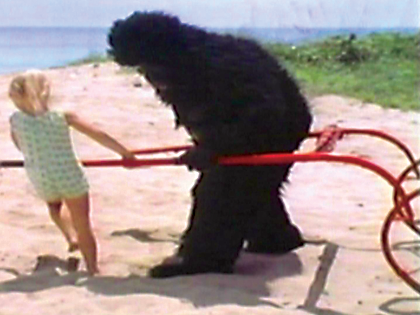
The children, being dullards, decide that a sleigh that couldn't be freed by eight reindeer might be moved by the kind of animals you would typically find at a petting zoo. One by one the children bring a miscellaneous animal (e.g., a donkey, a sheep, a pig), harness it to the sleigh, and then watch as the animal fails to do what eight large, magical animals working in concert failed to do. Santa, apparently as dimwitted as he was when he conquered the Martians, simply allows the children to waste their time and effort while sitting on his duff and muttering encouragement. By far, the most surreal moment occurs when, instead of a real animal, one child brings an actor in a shoddy costume a gorilla. I'm sure someone thought that this would be whimsical; instead it just comes off as creepy. You'd think that at least one of these children, who live within walking distance of a Florida beach, would have thought to bring a sand pail and shovel and simply dug the sleigh's runners out of the sand.

The horror...

With the children having exhausted all their ideas, Santa decides to encourage them by telling a story; a relatively faithful version of Thumbelina. Since this version of Thumbelina was originally a separate film that was shoehorned into this one, it has its own framing story as well as opening and closing credits. In this film within a film, a girl visits the Pirates World theme park (which was put out of business by Disney World shortly after this movie was released). While there, the girl listens to a recording of the story while admiring several associated dioramas. Most of this film consists of the the girl's imagining of the story, which is periodically interrupted by brief scenes of the girl moving on to another diorama while the recording drones on. The RiffTrax gang frequently points out how odd it is that Santa is apparently telling a story about a girl that's listening to a story at a pirate-themed amusement park.

Who doesn't think of the classic story of
Thumbelina when they think of Santa Claus?

The quality of the sets and the acting almost brings Thumbelina up to community theater standards, which is more than can be said about those parts featuring Santa Claus. Even weirder, in a 90 minute movie called Santa and the Ice Cream Bunny, a fairytale that has nothing to do with Santa or bunnies takes up about 60 minutes of the total running time. By the time Thumbelina has married the flower-fairy prince, the audience has mercifully forgotten that Santa Claus is even in this movie. Sadly, though, once Thumbelina's story is over we still have to get Kringle out of the sand.

Contrary to all reasonable expectations, Santa's story has inspired the children to run off and ask the Ice Cream Bunny to help. The children soon return on an antique fire engine with the Ice Cream Bunny at the wheel. As a parent, this whole sequence is utterly nerve-racking. It's painfully obvious that the actor in the bunny costume can barely see since he repeatedly has to jerk the wheel to keep the truck on the road, all while a dozen unrestrained children are riding on the vehicle. Santa greats his "old friend" warmly, confident that this mascot reject will save the day.

The Ice Cream Bunny, apparently a mute, merely nods while winking one poorly actuated eyelid. Thanks to Bill Corbett, this scene may very well be one of my favorite MST3K/RiffTrax moments. Whenever the camera focuses on the Bunny's horrifying face, Corbett supplies him with an utterly bizarre laugh. I can't even think about this scene without cracking up.


Having decided to use the fire engine to return to the North Pole, Santa and the Ice Cream Bunny climb into the truck and immediately drive off. Yes, this means that Santa simply leaves the children on the beach, apparently expecting them to walk home while he rides away on a mostly empty vehicle. Almost immediately after the fire truck is out of sight, the sleigh magically disappears. No, there is no explanation as to why Santa didn't demonstrate this kind of magic before. Given everything that came before I think we can safely say that he's an idiot and simply forgot that he can do magic.

Oh, and Huck Finn and Tom Sawyer show up on a raft at one point and watch the children's attempts to help Santa Claus. No, they don't actually contribute to the story nor is their presence explained. That's just the kind of movie this is.

F (but thanks to the RiffTrax guys it's one of the funniest movies I've ever seen)

LinkWithin

Related Posts with Thumbnails